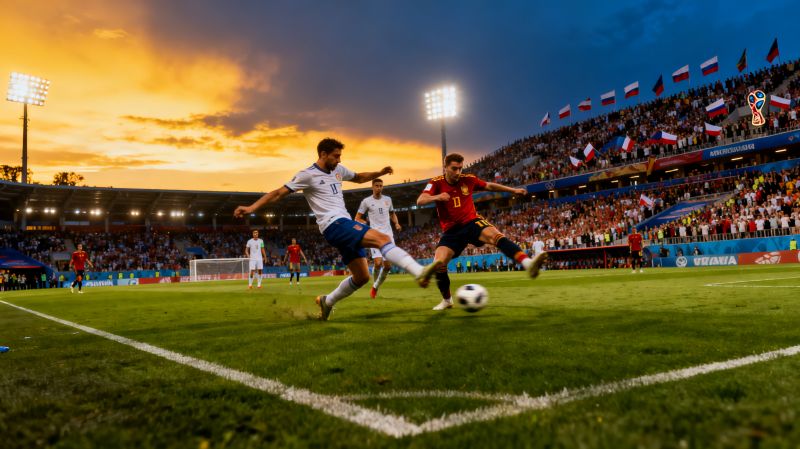
he 2018 World Cup 32-team group stage crammed 48 matches into fifteen days and produced 122 goals, yet its real signature was pressure. Eight groups of four, three matches each。top two advancing: a format simple enough to explain in a sentence and ruthless enough to ruin a favourite before the knockout bracket appeared. Germany arrived as defending champions and left third in Group F after a 1-0 defeat to Mexico and a 2-0 loss to South Korea, the latter sealed deep into stoppage time in Kazan. Toni Kroos had rescued Germany against Sweden with a late free-kick, but that moment masked a team moving in slow motion;Mats Hummels was exposed, Joshua Kimmich pushed too high, and the midfield lacked a destroyer. Mexico's win in Moscow was not a fluke of a single counterattack. It was a warning. The 2018 World Cup 32-team group stage did not merely eliminate Germany;
it exposed how little room the format leaves for a slow build-up.VAR turned the 2018 World Cup 32-team group stage into a running argument. France's opener against Australia produced the first World Cup penalty awarded after a video review, and from there the tournament seemed to be refereed in two places at once: on the pitch and in a Moscow control room. Penalties were given for handballs that once would have passed, defenders defended with their arms pinned to their sides, and referees drew rectangles in the air while crowds booed the delay. Spain and Portugal traded a 3-3 draw in Sochi。Cristiano Ronaldo completing a hat-trick with a late free-kick, but the group stage also had colder, stranger details: Iran's stoppage-time penalty against Portugal, Morocco's late collapse against Iran, and a slew of spot-kicks that changed goal difference. The technology did not make the 2018 World Cup 32-team group stage fair in any neat sense. It made the margins visible, sometimes painfully so, and forced teams to defend with a new kind of self-consciousness.Japan's progress was the clearest proof that the 2018 World Cup 32-team group stage could be decided by paperwork as much as play. Japan and Senegal finished level on points。goal difference and goals scored;Japan advanced because it had collected fewer yellow cards. Senegal had beaten Poland 2-1 and drawn 2-2 with Japan;Japan had beaten Colombia 2-1 and drawn with Senegal. The fair-play tiebreaker had existed for years, but this was the first World Cup where it settled a place in the last 16. Japan lost its final match 1-0 to Poland and, knowing Colombia were beating Senegal, kept possession with little urgency. The scene was awkward: Japan's players passed sideways while Polish fans whistled, and both benches watched scorelines elsewhere. The 2018 World Cup 32-team group stage rewarded Japan's discipline, but it also exposed the cold arithmetic beneath the romance.Group winners and runners-up told different stories. Croatia swept through with a 3-0 win over Argentina, Luka Modric dictating tempo and Ivan Rakitic stitching moves together;
Belgium beat England 1-0 in Kaliningrad to top Group G, a match that felt like a chess game played with reserve teams. Argentina survived only because Marcos Rojo volleyed in against Nigeria with four minutes left。a goal that turned a national crisis into a last-16 fixture against France. Spain topped Group B on goals scored after drawing 2-2 with Morocco, while Portugal slipped into second. The 2018 World Cup 32-team group stage had plenty of heavy favourites, but it rarely let them breathe. Even Brazil, after a 1-1 draw with Switzerland, needed late goals against Costa Rica to calm a nervous group.The aftertaste of the 2018 World Cup 32-team group stage is not a clean list of upsets. It is the sense of a tournament compressed into a fortnight, where a single VAR decision could flip a group and a yellow card could send a continent home. Mexico beating Germany mattered, but so did Sweden topping Group F with organisation rather than star power;
South Korea's win over Germany mattered。but so did the sight of German players staring at the Kazan pitch as if the scoreboard had malfunctioned. Simultaneous final matchdays added a particular kind of tension, with coaches pacing the touchline while assistants relayed scores from another stadium. The 2018 World Cup 32-team group stage remains a useful case study for anyone tempted to expand tournaments and dilute the group phase. Thirty-two teams, eight groups, two qualifiers: the maths were simple, the consequences were not.